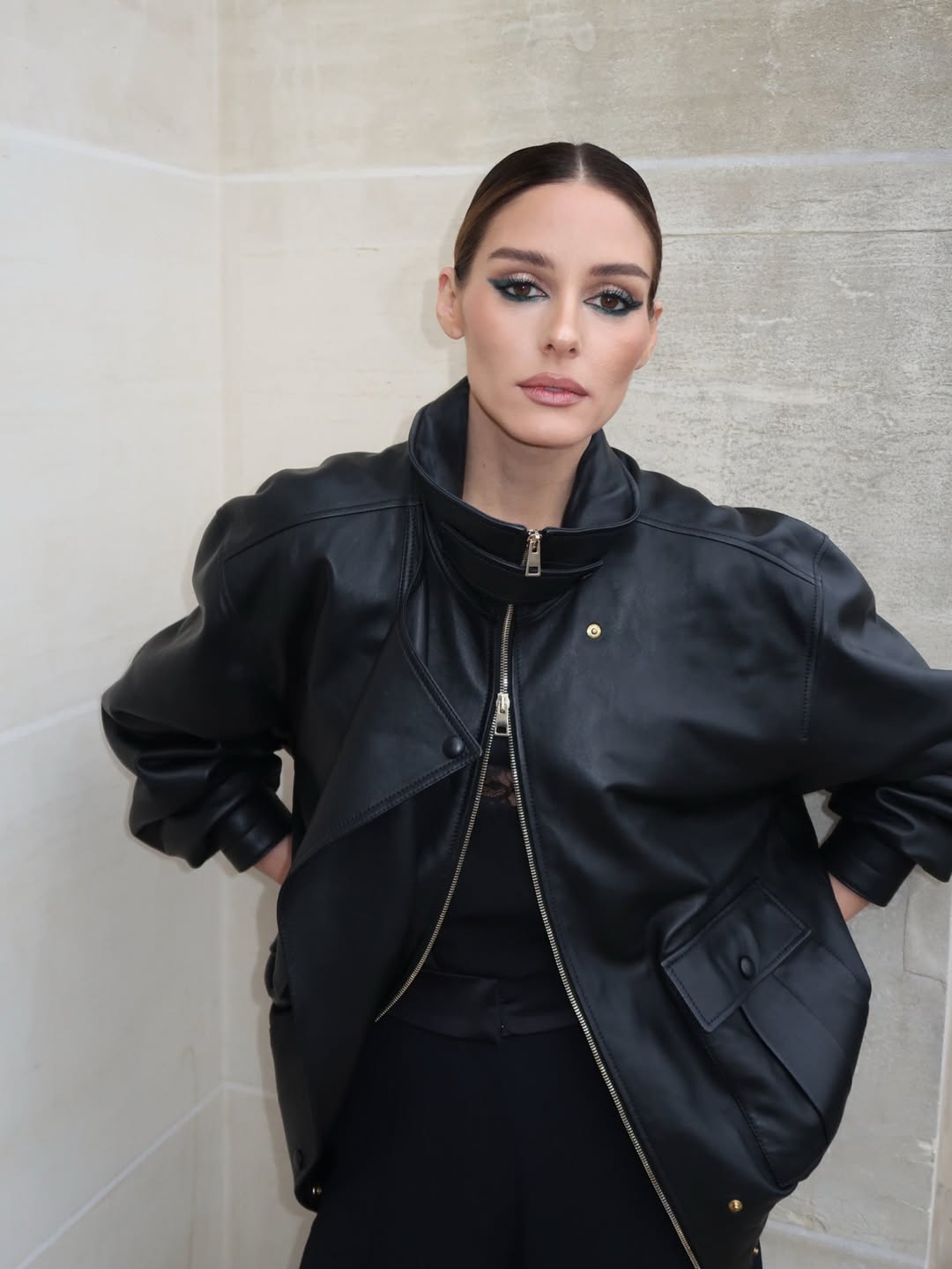
The Architecture of Presence: Redefining the Black Leather Armor
There is a long-standing myth in fashion that to be powerful, one must be loud. We are often told that “Power Dressing” requires sharp pinstripes, aggressive silhouettes, or perhaps a saturated primary color that demands the room’s undivided attention. But on a quiet morning in the city, set against the neutral, stoic grain of a stone facade, a different kind of authority has emerged. This look—centered around a sculptural, oversized black leather jacket—is a masterclass in what happens when restraint meets absolute confidence. It isn’t just an outfit; it’s a study in the geometry of presence. It’s the kind of styling that doesn’t just “halt a scroll” on a WordPress feed; it shifts the air in the room.
Let’s start with the jacket, because to call it mere outerwear is an analytical failure. In the history of subculture, the black leather jacket has played every role from the rebel to the punk, from the biker to the rockstar. But here, it has been stripped of its street-level grit and reassembled as a piece of high-fashion architecture. The silhouette is intentionally exaggerated, nodding to the 1980s power tailoring where a strong shoulder was a woman’s primary tool of negotiation. However, this isn’t a vintage throwback. Cocooned, voluminous, and unquestionably modern, the proportions are evolved. When you look at those shoulders, you don’t see a costume; you see a frame. It draws the eye upward, forcing a certain posture, a certain way of occupying space. It is literal armor for the modern ego.
What makes this leather work so well is the tension between its hardness and its fluidity. Leather, by nature, is an animalistic material, but when treated with this level of precision, it becomes as sleek as obsidian. The hardware is kept to a functional minimum—a visible silver zipper that provides a sharp vertical line, slicing through the matte richness of the hide. This zipper is more than simply a fastener; it’s a design element that lengthens the torso and gives an already statuesque frame a sense of height. The high collar adds to the feeling of “guarded” elegance by protecting the neck. It is a deliberate wall separating the wearer from the outside world, implying that access to the individual within is a luxury rather than a right.
Beneath this heavy, structural layer, the all-black foundation continues, but it’s here that the “monochrome myth” is debunked. People often think wearing black on black is the easy way out, a safe choice for the uninspired. In reality, it is one of the most difficult styling feats to master because you are no longer relying on color to create interest; you are relying entirely on the interplay of light and texture. The smooth, semi-matte sheen of the leather jacket rests against the softer, light-absorbing fabrics of the inner layers. This creates a visual depth—a “black hole” effect that pulls the viewer in. It’s a conscious decision that puts the silhouette ahead of the shade.
The unsung heroes of this geometry are the pants.Yes, they are fitted, but they also have a loose flow that keeps the style from appearing rigid or “corporate.” Their fluid grace counteracts the jacket’s boxy, top-heavy weight. They are tailored, yes, but they possess a relaxed fluidity that prevents the look from feeling stiff or “corporate.” They move with a certain liquid grace that balances the boxy, top-heavy weight of the jacket. It’s a game of proportions that every fashion editor obsessively plays: if the top is loud in its volume, the bottom must be quiet in its drape. By keeping the waistline high and the line unbroken from hip to floor, the outfit creates an illusion of endless length. It makes the wearer look grounded, like a sculpture fixed to a pedestal, yet ready to move at a moment’s notice.
But an outfit is never just about the clothes; it is about the “break”—that moment where the styling meets the human being. This is where the beauty coordination comes into play, and it is here that the look moves from “good” to “unforgettable.” The makeup is a masterclass in selective drama. We see a graphic, extended sweep of eyeliner—sharp enough to cut and dark enough to hold a gaze. In a world of “clean girl” aesthetics and “no-makeup” trends, this is a radical return to intentionality. The eyeliner doesn’t just frame the eyes; it reinforces the architectural lines of the jacket. It mirrors that sharp shoulder. It says that the person inside the armor is just as focused as the armor itself.
The rest of the face is a study in restraint. The skin is luminous, but it isn’t “dewy” in a youthful, fragile way; it’s sculpted. The contouring follows the bone structure with the same precision as a tailor’s stitch, highlighting the cheekbones to match the jacket’s silhouette. The lips are kept neutral, a satin finish that refuses to compete with the eyes. This is the “Visual IQ” of styling: knowing exactly where the focal point should be and having the discipline to leave the rest in silence.
The hair, too, is part of this clean, minimal narrative. A center-parted low bun, slicked back without a single strand out of place. It’s a hairstyle that communicates control. It keeps the silhouette crisp from every angle, ensuring that the collar and the shoulders remain the primary actors in this visual play. By pulling the hair back so severely, the focus remains entirely on the face and the architecture of the clothes. It’s a choice that feels both ancient and futuristic—a kind of timeless urban grooming.
Why does this look feel so relevant for a 2026 fashion feature? Because we are currently living through a period of “aesthetic fatigue.” We are tired of the maximalist spectacle, the loud logos, and the frantic chasing of micro-trends that disappear within a week. This look represents a return to permanence. A high-quality leather jacket and a perfectly tailored trouser aren’t items you wear for a season; they are items you inhabit for a decade. They gain character. They collect memories in their creases. This is the “Modern Mogul” aesthetic—the idea that luxury is found in the quality of the line and the confidence of the wearer, not the loudness of the price tag.
The neutral stone backdrop of the photography isn’t accidental either. It provides a “symphony of grays” that allows the deep black of the leather to pop without the distraction of a busy street. It reinforces the idea of “Quiet Luxury”—that true power doesn’t need a neon sign; it just needs a solid foundation. The contrast between the warm, porous stone and the cool, reflective leather is a textural dialogue that makes the whole image feel like a high-end editorial spread.
For the readers of a fashion WordPress, the takeaway here is the power of the “Uniform.” We often think of a uniform as something that limits us, but for the most influential people in fashion, a uniform is a liberation. It removes the decision fatigue of the morning and replaces it with a signature. This look—this specific combination of oversized leather, tailored black trousers, and graphic eyes—is a signature. It tells the world who you are before you’ve even opened your mouth. It speaks of a woman who values her own time, who understands the language of proportion, and who isn’t afraid to take up space.
Ultimately, this ensemble is about the evolution of femininity. It’s not about blending into a masculine world by wearing a man’s suit; it’s about taking those masculine elements—the leather, the zip, the broad shoulder—and infusing them with a distinctly feminine sensuality and artistic flair. It is powerful without being aggressive. It is sensual without being overt. It is a reminder that in the crowded, noisy landscape of modern fashion, the most striking thing you can be is composed. As she stands there, framed by the stone and the light, she isn’t just wearing an outfit. She is demonstrating the enduring power of a well-curated silence.
No responses yet