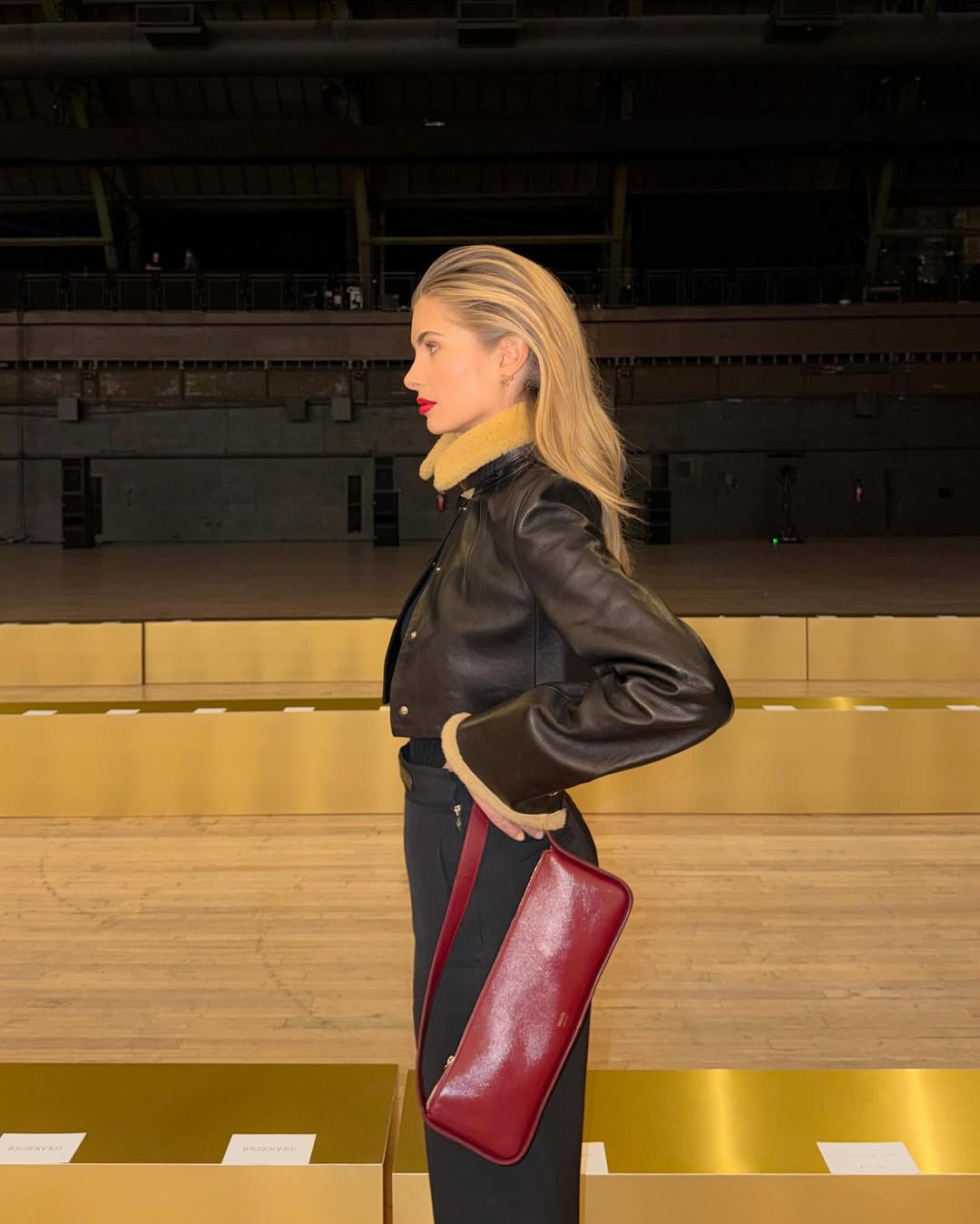
There is a specific, potent form of glamour that exists in the transition between runway and street—the “off-duty” energy that commanded attention before the maximalist spectacle took over. It is a style rooted in the assumption that the wearer is the subject, and the clothes are merely the atmosphere. This ensemble, centered around a cropped leather bomber, is the definitive blueprint for that shift: a masterclass in modern composure, tactile contrast, and what happens when functionalism becomes an art form.
Standing against the sun-baked terracotta of a classic facade (or perhaps the textured stone of a Milanese courtyard), this look functions as a visual essay on “Voluminous Autonomy.” It proves that “Quiet Luxury” doesn’t have to be a sterile void of beige cashmere; it can be loud in its proportions, bold in its geometry, and visceral in its texture, provided the harmony remains intact. This isn’t just a look; it is an attitude—a calculated play on personal space and urban resilience.
The Protagonist: The “Duvet” Jacket and the Art of the Shell
The undisputed protagonist of this narrative is the jacket. To call it merely a “leather jacket” is an analytical failure; it is a portable sanctuary. In an era where smooth, buttery lambskin has become the predictable (and frankly, flat) default for luxury, the choice of a padded, almost duvet-like structure is a radical act of high-fashion functionalism. The volume isn’t just about insulation; it is architectural. This is where the “New Minimalism” enters the conversation. Minimalism has always been about stripping away excess, but in 2026, it is also about embracing form.
The jacket relies solely on its material and silhouette to draw attention because it lacks any obvious hardware or conspicuous branding. The padded volume catch the flat urban light, creating a rhythmic map of deep shadows and muted, semi-matte highlights. It doesn’t scream “look at me”; it hums with a quiet, undeniable presence. It is the bridge between the “salons” of mid-century couture and the high-density reality of the modern city, evoking a nostalgic yet entirely relevant form of urban armor.
The Psychology of Proportion: The Inverse Triangle
The whole thing revolves around that visual contradiction: oversized everything up top, stripped-down everything below. It’s not a new concept—the “inverse triangle” has been a street style staple for years—but it is being executed here with a discipline that makes it feel fresh again. By pairing such massive upper-body volume with bare legs and a mini-hemline, the wearer prevents the outfit from swallowing her frame. It is a game of visual physics: the wider the jacket, the leaner and more elongated the legs appear.
This tension between the protective, heavy shell and the deliberate exposure of skin is what makes the outfit feel truly interesting. It avoids the aggressive body-con tropes of the past while remaining undeniably powerful. Without the bare legs, the outfit might feel clunky or heavy; with them, it feels bold, balanced, and strangely unbothered by the elements. It’s an aesthetic born of nomadic luxury—the image of a woman moving through a gray, windy city while remaining entirely cocooned within her own well-engineered world.
The Grounding: The Stomper Sole as a Pedestal
To anchor a jacket this large, delicate footwear would be a catastrophic failure. A slim sneaker or a dainty flat would make the wearer look like a bobblehead. Instead, the choice of a platform tech-sneaker with a thick lug sole is essential. The “Stomper” aesthetic provides the necessary visual weight. The ruggest, gear-like tread acts as a literal pedestal for the entire architectural experiment. It adds volume at the bottom to balance the volume on top, grounding the look with a sense of decisive urban utility.
What makes this footwear choice truly modern is the texture shift. In an all-black palette, the change from the soft, matte hide of the puffer to the shiny, hard rubber of the tech-sole provides the necessary visual contrast. It is a study in material honesty, combining the high-fashion editorial of the jacket with the practical, walk-miles-through-the-city functionalism of the platform sneaker. The sole doesn’t just support the wearer; it complements the garment’s structure.
Accessory as Punctuation: The Geometry of a Break
In a monochromatic look, accessories aren’t just additions; they are punctuation marks that determine the rhythm of the entire sentence.
First, consider the eyewear. Thick-framed, geometric, and unapologetically black. They are the antithesis of the oversized “glam” lenses of the past. They cut through the softness of the puffer curves with sharp, architectural precision. They add a layer of mystery and urban grit, functioning less as a visual aid and more as a “personal zone” signal. They say “don’t bother me,” while the jacket says “I take up room.” It’s a powerful communicative act.
Then, there is the bag—the only moment of visual disruption. A small tote with a black-and-white graphic print (maybe a subtle logo pattern, but hopefully something more abstract and art-focused). This is the visual IQ of the outfit. In a solid, deep-black composition, the eye naturally craves a break, a point of narrative tension. The print provides that tension. It adds a layer of personality and prevents the monochrome from feeling too “salon-ready” or clinical. It brings the look back to the spontaneous energy of city life, suggesting that while the wearer respects the discipline of minimalism, she isn’t afraid of a bit of playful subversion.
Finally, we must talk about the hair. With a collar that high and a jacket that wide, there is only one choice: the sleek, low-slicked bun. Loose hair in an outfit like this creates a chaotic mess of textures that hides the face and ruins the silhouette. By slicking the hair back so severely, the wearer highlights her bone structure and allows the jacket’s architecture to be the primary actor. It is a clean, decisive finish that communicates absolute intention. Nothing about this look is accidental; every strand and every zipper is part of a broader, cohesive narrative.
Why This Hits: The New Urban Autonomy
Why does this look feel so urgent and relevant in 2026? We are experiencing a period of aesthetic exhaustion, which is the reason. We are yearning for a return to permanence because of the loud logos, the maximalist spectacle, and the desperate pursuit of microtrends created especially for social media participation.This outfit represents that sanctuary.
It bridges the gap between high-fashion editorial and real-world practicality. You can stay warm, stay dry, walk miles, and still look like you just stepped out of a spread. It is high-fashion functionalism at its peak.
Ultimately, this look isn’t just about the jacket; it’s about claiming your own physical and mental space. In a world of high-velocity digital noise, choosing a silhouette that functions as a literal buffer is a radical act of self-preservation. This is the new “Office Siren” or “Modern Mogul”—a woman who doesn’t need to shout to be heard. She demonstrates that true authority doesn’t come from being noticed; it comes from the quiet, unshakeable confidence of being entirely in your own world. The clothes are doing the talking, and they are speaking the language of a confident, resilient, and quietly, undeniably powerful modern femininity. When the lines are this sculptural, you don’t pose; you just walk with purpose, and the outfit does the rest.
No responses yet