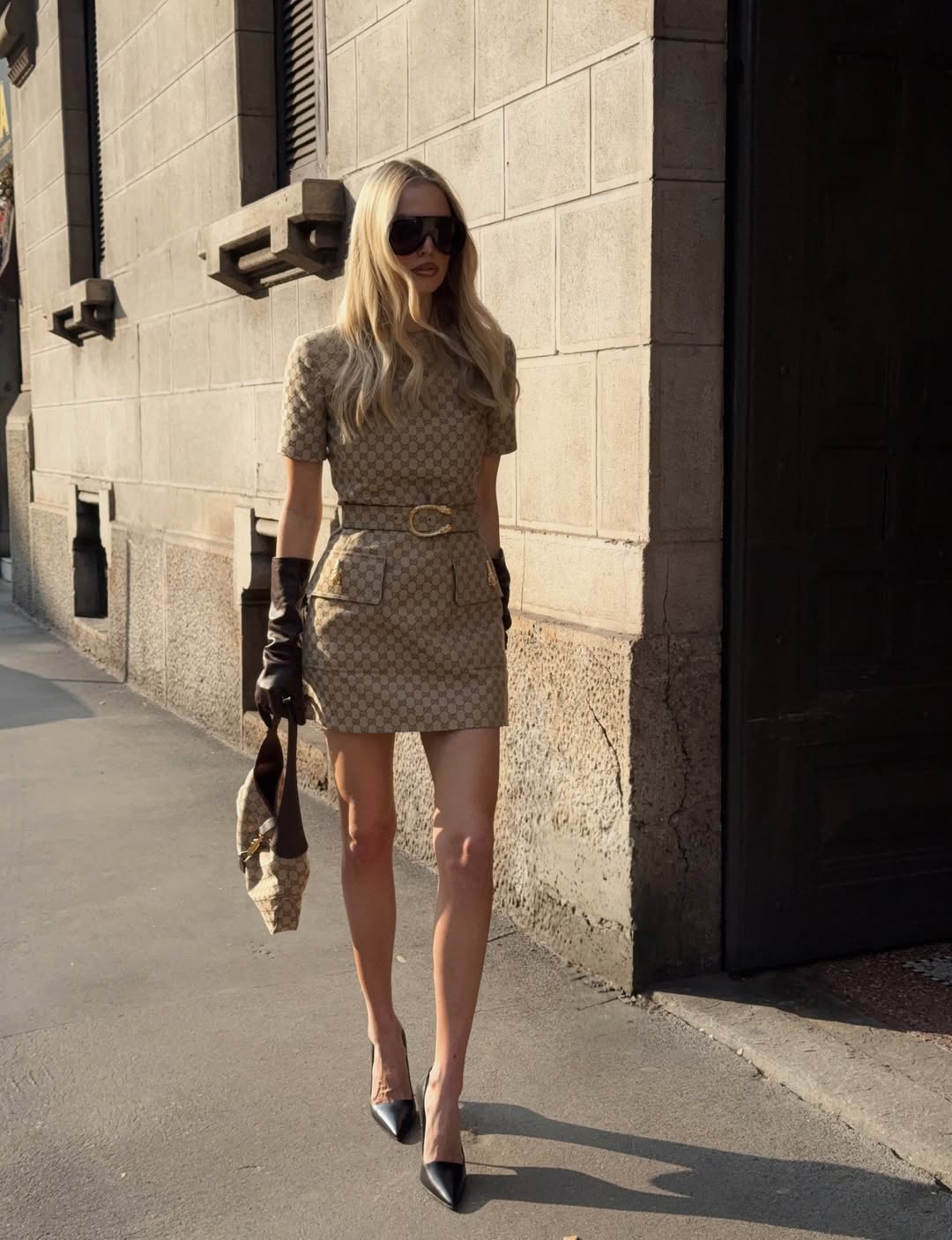
The Monogram Dress: How to Wear It Without Looking Like a Billboard
The first reaction to a monogram dress is often that it’s too much — too logo-forward, too obvious. The concern that covering the entire body in a brand pattern might read as excessive is understandable. But seeing a monogram dress worn well tends to change that view.
Monogram patterns function closer to a solid color than most people expect. The denser and more uniform the pattern, the more it reads as a single tone from a distance. That’s why wearing it head to toe doesn’t feel visually busy — it actually creates a clean, unified impression. Add the inherent identity of the brand itself and the result is something that reads as a complete style statement rather than just a dress.
That said, wearing a monogram dress well is different from simply putting on something with a logo on it. The silhouette, the accessories, and what you add and leave out are all things that can make the look feel thought out or too much.
The key is recognizing that the dress is already enough. The moment you try to add more, the look starts to fall apart. The answer is in subtraction, not addition. Here’s how to get there.
Look Analysis: The Sophisticated Harmony of the Gucci Monogram
The Gucci GG monogram mini dress is covered entirely in the classic GG pattern — beige and brown interlocking in that immediately recognizable way. Short sleeves and a round neckline give it a silhouette that nods to the mod fashion of the 1960s and 70s, clean and structured in a way that feels genuinely classic. The mini length cuts at mid-thigh, leaving the legs fully exposed and adding a lightness and confidence to the overall mood. Flap pocket details on the skirt portion keep it from reading as a simple shift dress — the tailored touch brings a precision to the garment that makes the monogram pattern read as more three-dimensional and intentional, and gives the whole dress a neatness that a plainer silhouette wouldn’t have.
The Gucci belt with its GG buckle shares the same monogram identity as the dress while doing something distinct — the gold buckle creates a strong focal point at the waist that the dress alone wouldn’t have. It cinches the waist, sharpens the proportion, and the gold buckle adds just enough warmth and luxury to lift the whole thing. Repeating the brand identity in a tone-on-tone way like this could easily feel redundant, but the belt is exactly what keeps it from being so.
The dark brown leather gloves, extending above the elbow, add a dramatic elegance that nothing else in the look could achieve in quite the same way. There’s something very 1950s couture about long gloves, but worn here they read as completely current. Vintage glamour and modern cool at the same time. And the dark brown against all that warm beige adds just enough contrast to give the look some depth without throwing anything off.
The bag is a Gucci monogram hobo — the same GG canvas as the dress, carried in one hand with a soft, unstructured slouch that keeps the full monogram look from feeling too rigid or too formal. The gold hardware echoes the belt buckle above, and that repetition of the same metallic note across two different pieces pulls the look together with a coherence that feels deliberate. A head-to-toe monogram look is a bold choice, but here it resolves into something that feels like a single aesthetic statement rather than an accumulation of logo pieces. The dress and bag share the same pattern but differ enough in form and texture to keep the look feeling rich rather than repetitive.
The shoes are black pointed-toe pumps. Between the warm beige of the monogram and the deep brown of the gloves, the black pumps land at the bottom of the look and provide the sharpest, most definitive note in the entire outfit. The pointed toe extends the leg line all the way to the floor, and against the short hem of the mini dress, the effect on the leg length is significant.
The result is a look that uses a strong, all-over pattern as its foundation and yet never feels chaotic — because the color palette is controlled enough to let the pattern do its work without competing with anything else.
5 Essential Rules for Styling a Mini Dress
The mini dress has a range that few other pieces can match — it can read as playful and energetic, or sharp and sophisticated, depending entirely on how you style it. The exposed leg line is the whole point, which means everything else needs to work around that and keep the overall proportion feeling balanced.
Here are five ways to get the most out of it.
1. Use the layering contrast to your advantage
Whatever you put over a mini dress changes the entire mood of the look.
An oversized blazer is the most versatile option. Match it to the length of the dress or go slightly longer — the blazer’s structure tempers the shortness of the hem and brings the whole thing into a more polished, city-appropriate register without losing any of the energy.
A slim leather jacket takes it somewhere edgier. The femininity of a mini dress against the toughness of a leather jacket is a combination that consistently works — confident, cool, and a little bit unexpected.
2. Footwear defines the leg line
With a mini dress more than almost any other garment, the shoe makes or breaks the proportion.
Knee-high boots are the most dramatic option. The sliver of leg between the hem and the top of the boot concentrates the eye in a way that makes the legs look significantly longer. It’s also the best way to wear a mini dress in autumn or winter without losing any of its impact.
A pointed-toe flat or heel extends the line of the leg all the way to the floor — even without a significant heel height, the sharp tip creates a slimming, lengthening effect that a rounded toe simply can’t replicate.
3. Top-Heavy Harmony: The Volume Balance
Because the skirt is short, it’s worth thinking about how much skin or volume is happening above the waist. Too much on both ends and the look loses its balance.
Long sleeves or puff sleeves provide a counterweight to the short hem. The added volume or coverage on top creates a visual contrast with the exposed lower half that makes the whole silhouette feel more considered and more elevated.
A halter neck mini dress does the opposite — it draws attention upward through the shoulder and neckline, which creates a height illusion and gives the look a more athletic, vital energy.
4. Define the waist
Where the waistline sits on a mini dress determines the proportion almost entirely.
An empire line — where the waist starts just below the bust — places the visual division point as high as it can go, which makes the leg line appear to begin much higher than it actually does. It’s one of the most effective proportion tricks a dress can have built in.
If the dress is more boxy or relaxed, add a thin belt tied slightly above the natural waist. Just locating the waist visually is enough to transform a shapeless silhouette into something that feels intentional and polished.
5. The sock detail is worth trying
One of the most current ways to style a mini dress right now involves socks — and it works better than it sounds.
Sheer socks with loafers bring a preppy, slightly schoolgirl sensibility to a mini dress that feels both classic and current at the same time.
Color-pop socks are the more playful version. If the dress is neutral or monochrome, a sock in a saturated, unexpected color adds a wit and personality to the look that a plain sock just wouldn’t.
Pro-Tip: Testing Comfort in Motion
One last thing: always check how a mini dress moves before you commit to wearing it out. It will always sit shorter when you’re walking or sitting than when you’re standing still. Find the length that feels genuinely comfortable in motion — not just in front of the mirror — and that’s the length that will look the best on you consistently.
No responses yet