Check Pattern: How Do You Wear It Without Looking Dated?
Everyone knows check pattern is a classic. So why does it so often end up looking a little off? If you’ve ever put together a check jacket outfit and felt like something wasn’t quite working, you’re not alone.
Check is a genuinely tricky pattern to wear. Get it wrong and it reads as too formal — almost school uniform territory. Overcorrect in the other direction and it starts to feel forced, like you’re trying too hard to make it look cool. The line between the two is thinner than you’d expect.
The key is to stop treating check as a formal item. Counterintuitively, check looks most natural when it’s placed against the most casual pieces you own. That’s when the classic quality of the pattern actually comes through, rather than working against you. Here’s how to make that happen.
Look Analysis: The Y2K Spin on Classic Plaid
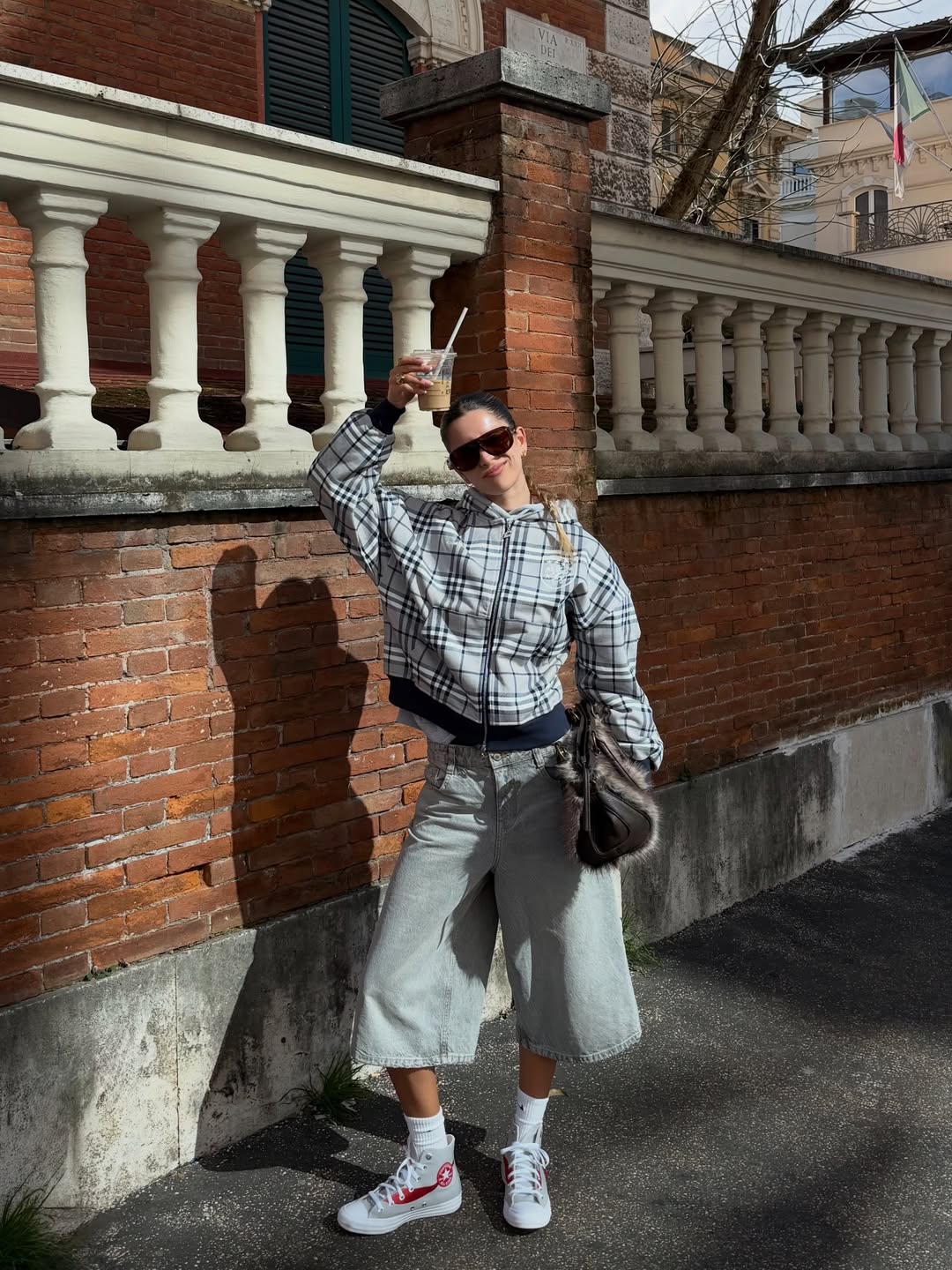
The cropped check hood zip-up jacket is the standout piece of this look. A grey, black, and white plaid pattern gives it a vintage quality that runs through the whole outfit. The cropped length works in favor of the proportion — it raises the visual starting point of the lower half and makes the legs read as longer. The navy banding at the hem and cuffs adds a sporty edge, and the grey hood layered underneath the jacket adds depth to the upper half without introducing another color into the mix.
The jeans are light-wash denim — but not a standard short. The leg is wide and generous, falling below the knee in a baggy, relaxed silhouette that’s been referred to as baggy shorts or bermuda shorts. It’s one of the more prominent trends in street fashion right now, drawing from 90s and early 2000s skate culture and currently being reconsidered as one of the more interesting silhouettes in casual dressing. The light grey wash of the denim sits naturally alongside the grey of the check jacket, creating a tonal cohesion across the upper and lower halves that keeps the look feeling unified rather than disconnected.
The shoes are white high-top Converse with a red accent — and that red is doing meaningful work in a palette that’s otherwise built entirely from grey, navy, and light blue. The cool tones of the outfit needed a single warm note, and the red delivers it without overwhelming anything. The high-top silhouette connects the ankle to the hem of the baggy shorts in a way that feels natural, and the white socks folded over the top of the shoe add the specific Y2K character that the rest of the look is referencing.
The bag is a mini in dark grey fur with brown tones mixed in, leather handles, and gold hardware. In a look built from denim and plaid, the fur introduces a richness of texture that neither material can provide on its own. The dark grey connects back to the jacket, and the tactile contrast between the rough sportswear pieces and the soft luxury of the fur is what makes the bag feel like a considered choice rather than an afterthought.
The gold jewelry on both hands connects tonally to the brown in the fur bag — the warmth of the gold and the warmth of the brown sit well together and add a quiet luxury to what is otherwise a very casual outfit. The sunglasses are a dark brown lens oval frame that closes the look out cleanly.
5 Essential Rules for Mastering Check Patterns
Check pattern is one of the most classic things you can wear — and also one of the easiest to get wrong. Too much of it in the wrong context and it tips into looking stiff or dated. Here are five ways to wear it well.
1. Use the Scale of the Check to Control Proportion
The size of the pattern is a useful tool for managing how the body reads.
Large checks — windowpane, buffalo — create a visual expansion. If your upper body is on the slimmer side, a big check shirt or jacket adds volume in a way that feels deliberate rather than accidental.
Small checks — gingham, houndstooth — read almost as a solid from a distance. On the lower half, a fine check pattern creates a slimming effect that a bolder print wouldn’t.
2. Color-Match with the Pattern’s Palette
Check is already doing a lot visually, which means everything else should take its color cues from the pattern rather than introducing something new.
If the jacket is a brown-based check, match the trousers or inner layer to either the lightest beige or the darkest brown within that pattern. The look stays cohesive rather than busy.
If the check feels like too much on its own, a black or white inner layer acts as a neutral reset — it lets the pattern read clearly without anything competing alongside it.
3. Keep the Bottom Half Simple
Check carries a high amount of visual information, which means the lower half should do as little as possible.
Pick the most dominant background color in the check — or the darkest line — and match the trousers to that. A grey glen check jacket with black trousers, for example, draws the eye upward and lets the pattern do its work without the lower half adding to the noise.
4. Pair with Denim for a Modern Preppy Look
Check and denim is one of those combinations that doesn’t really go out of style.
Tuck a gingham or tartan check shirt into raw denim or a medium-wash vintage jean. Add tortoiseshell glasses and loafers and the look lands in a specific, knowing preppy territory that feels current rather than dated. Leave a button or two undone and roll the sleeves — it loosens the whole thing up considerably.
5. Minimalist Accessories for Maximum Impact
Check already has enough going on. Bold jewelry competes; simple gold or silver lines support.
A thin leather belt over an oversized check coat or jacket is one of the more effective proportion adjustments you can make — it defines the waist and counteracts the tendency for a large pattern to read as shapeless.
Pro-Tip: The Art of Mixing Patterns
One last thing: if you want to try check-on-check, make sure the two patterns are different in scale. One large, open check alongside one very small, fine check — the contrast in scale is what stops them from clashing and what makes the combination feel intentional rather than accidental.
No responses yet