If You Have an Oversized Shirt Sitting Untouched in Your Wardrobe: The One-Strap Fix
You bought the oversized shirt, but when it came to actually wearing it, something felt off. The volume was right, but putting it on made you disappear into it — no shape, no waist, nothing. So it ended up pushed to the back of the wardrobe.
This is the central problem with oversized shirts. The relaxed fit is the whole appeal, but that same looseness is what kills the silhouette. You may have tried a belt at some point, only to find that looked awkward too.
The fix is simpler than you’d expect. A strap is enough.
Whether it’s a strap that came attached to the shirt or a separate tie added on — one strap detail is all it takes to preserve the volume of an oversized shirt while creating a waist, and to turn something ordinary into a look that actually works. No forced tucking, no awkward belting. Here’s how to use it.
Look Analysis: The Power of Cinching and Tailoring
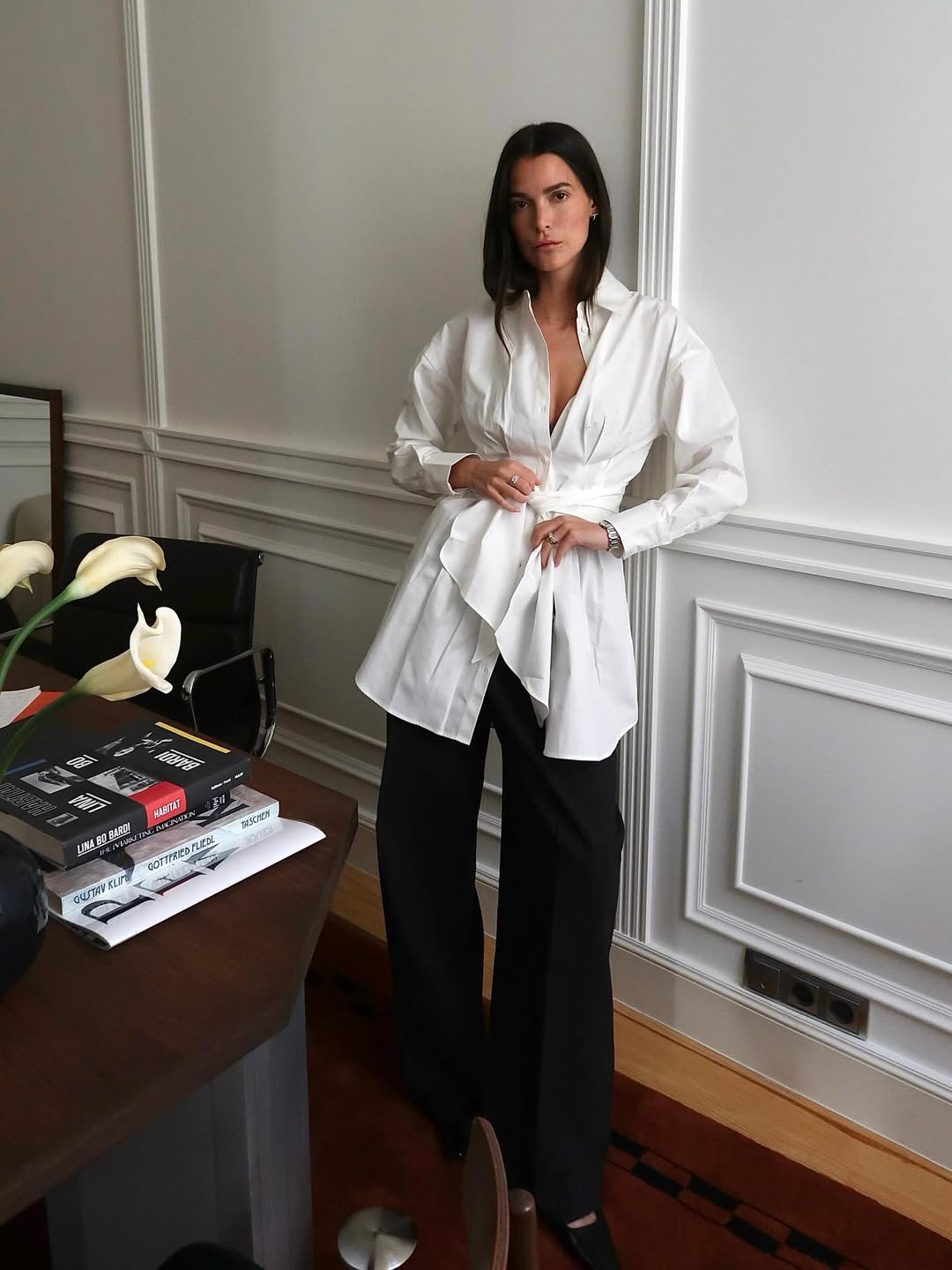
The long attached straps on the white oversized shirt are tied into a bow or knot at the waist. It’s a simple adjustment that does a lot — it defines a clear waistline on a shirt that would otherwise read as shapeless, and it raises the visual starting point of the lower body, making the legs appear longer. The drape that falls naturally from the front of the knot adds movement and keeps the look from feeling static. The buttons are left open low enough to create a deep V-neckline, which removes any sense of the shirt feeling closed-off or corporate, and introduces a sensuality that balances the formality of the rest of the look. The length is generous — covering the hips — and the hem flares out enough that the shirt carries an almost dress-like quality. The crisp cotton holds its structure without collapsing, which is what keeps the draped silhouette looking intentional rather than just undone.
The black wide-leg trousers do the work of absorbing the energy of the top half and bringing the look back into balance. What appears to be a fine pinstripe gives them a tailored, suit-trouser quality that reads as professional and considered. The floor-grazing length and the wide leg add an ease and a masculine weight that contrasts directly with the feminine, waist-emphasizing quality of the shirt above. Where the shirt draws attention to the curve of the waist, the trousers extend in a straight, unbroken line downward — the two halves pull in opposite directions, and that tension is what gives the look its shape.
Because the silhouette is doing most of the work, the accessories are kept to a minimum. The shoes are black — either a square-toe or pointed-toe mule or pump. The sharpness of the toe creates a contrast with the fluid line of the wide-leg trousers and gives the lower half a precision that the volume of the trousers alone doesn’t have.
The only jewelry is a bold ring or two in silver or white gold, and a watch. Nothing more than that — enough to give the look a quiet polish without overwhelming the shirt.
5 Essential Rules for Styling an Oversized Shirt with Straps
Adding a strap detail to an oversized shirt is one of the more effective ways to give the silhouette definition without losing the relaxed quality that makes an oversized shirt worth wearing in the first place. Whether the strap is built into the shirt itself or added separately, here are five ways to use it well.
1. Cinch the waist for an X-line silhouette
The whole appeal of an oversized shirt is the volume — and a strap at the waist is what turns that volume into a shape.
Try crossing the strap at the waist and tying it. Tied at the back it creates a clean, minimal effect; tied at the front it reads as more romantic. Pair with biker shorts or leggings on the bottom to let the volume of the shirt read as the focal point.
2. Create an unbalanced shoulder
Using the strap to pull one shoulder slightly lower than the other creates an off-shoulder effect that immediately feels more current and directional.
Fix the shirt in a slightly off-center position using the strap. Layering a clean bra top or a black turtleneck underneath reduces the exposure while keeping the editorial quality of the look intact.
3. Push the sleeves up and use the strap to hold them
If the shirt has a strap at the cuff, try pulling the sleeve up to the elbow and securing it there with the strap.
The gathered fabric creates a balloon sleeve effect that adds volume to the upper arm while actually making the forearm and wrist look leaner. It’s also a practical adjustment that makes the shirt easier to wear day-to-day — and it reads as effortless rather than styled.
4. Layer a strap vest over the shirt
Placing a short vest with strap detailing — or a harness-style accessory — over an oversized shirt adds a layer of visual interest that the shirt alone doesn’t have.
A black strap vest over a white oversized shirt is a particularly clean version of this. It draws the eye upward, adds structure without adding bulk, and gives the look a focal point that keeps it from reading as too relaxed.
5. Let the strap hang loose
Not everything needs to be tied. Leaving a long strap to hang freely creates a movement and a looseness that reads as either bohemian or avant-garde depending on the rest of the look.
Leave the strap on the side seam or back panel untied and let it move as you walk. It adds a dynamic quality to the silhouette that shows up particularly well in photographs.
Pro-Tip: The Golden Rule of Tension
One last thing: when tying a strap, leave a little room — roughly enough for one or two fingers to slip through. Too tight and the shirt loses the flowing quality that makes it interesting in the first place. The right tension is where the structure of the strap and the softness of the shirt work together rather than against each other.
No responses yet